Quick Facts
- Distribution: Approximately 55% of the population follows the bear chronotype, while night owls and early birds each account for about 15% of the population.
- Genetic Link: Up to 50% of your sleep personality is determined by biology, specifically the PER3 gene and various genetic loci.
- Cognitive Edge: A 2024 study of over 26,000 individuals found that those who identify as night owls typically exhibit superior cognitive function compared to early risers.
- Health Risks: Research indicates that night owls may face a 10% higher risk of early death than early birds, largely due to chronic social jetlag.
- Peak Performance: The Synchrony Effect suggests that cognitive tasks are 30% more effective when performed during your specific productivity windows.
- The Goal: Aligning your biological clock with your daily responsibilities reduces sleep debt and chronic fatigue.
Understanding your biological clock starts with a chronotype quiz. This diagnostic tool is based on circadian rhythms and identifies your specific sleep personality types, allowing you to identify your natural peak energy periods and adjust your daily life to match your natural rhythms for better long-term wellness.
Do you thrive at dawn or find your spark at midnight? For most of us, the traditional nine-to-five workday feels like a one-size-fits-all garment that rarely fits quite right. Some of us wake up ready to conquer the world, while others need three cups of coffee just to remember their own name. This variation isn't a matter of discipline or willpower; it is rooted in your chronobiology. By identifying your chronotype, you can stop fighting against your internal biology and start working with it to improve your productivity, mood, and heart health.
Identifying Your Type: The 7-Question Chronotype Quiz
You don't need a laboratory sleep study to understand your biological preferences. This interactive checklist helps you determine how to identify your chronotype using a sleep personality quiz by looking at your daily energy fluctuations.
Review the following statements and note which ones resonate most with your daily experience:
- I wake up naturally between 5:00 AM and 7:00 AM without feeling groggy.
- My peak alertness occurs in the late morning, and I often feel a significant "slump" after lunch.
- If left to my own devices, I would rarely go to bed before midnight.
- I am often hungry for a large breakfast immediately after waking up.
- I find my most creative thoughts happen when the rest of the house is quiet and asleep.
- I struggle with traditional sleep-wake consistency and often find myself staring at the ceiling at night.
- I feel most productive when I can tackle difficult, analytical tasks in the early afternoon.
If you identified mostly with the first two points, you likely lean toward the Lion category. If the third and fifth points felt more like home, you are probably a Wolf. If you feel solar-aligned and functional during the standard workday, you are likely part of the Bear majority. If you felt most connected to the point about being a light or irregular sleeper, you might be a Dolphin.
The Four Sleep Personalities: Lion, Bear, Wolf, and Dolphin
In the world of preventive healthcare, we use animal archetypes to make complex circadian rhythms easier to understand. Each type has specific morning person vs evening person traits that dictate when melatonin levels rise and when cortisol rhythm peaks.
| Chronotype | Population % | Peak Energy Window | Primary Trait |
|---|---|---|---|
| Lion | 15% | 8:00 AM – 12:00 PM | Early riser, proactive, disciplined |
| Bear | 55% | 10:00 AM – 2:00 PM | Solar-aligned, social, steady |
| Wolf | 15% | 5:00 PM – 9:00 PM | Creative, late-night peak, impulsive |
| Dolphin | 10% | 3:00 PM – 7:00 PM | Intelligent, light sleeper, anxious |
The Lion: The Early Achiever
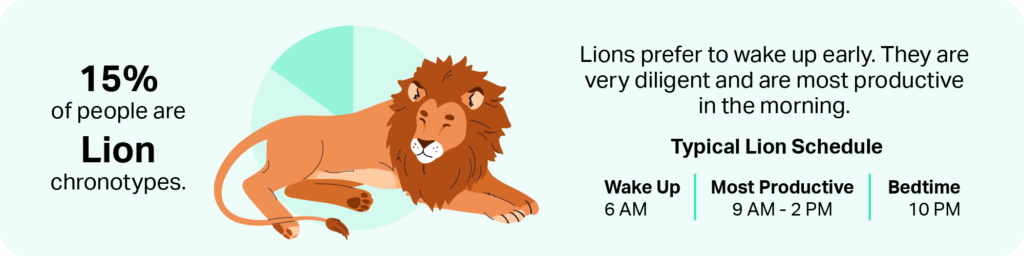
Lions are the quintessential early birds. They wake up early with ease and find their peak alertness occurs almost immediately. When looking at lion chronotype vs bear chronotype traits, Lions are much more morning-dominant, often completing their most demanding work before noon. However, they tend to "crash" early in the evening, making them less suited for late-night social events.
The Bear: The Solar Standard
Bears make up the majority of the population. Their biological clock follows the sun. They wake up with the sunrise and wind down as it gets dark. Most societal structures are built for the Bear, which means they suffer the least from circadian misalignment. They are most productive in the mid-morning to early afternoon.
The Wolf: The Late-Night Visionary
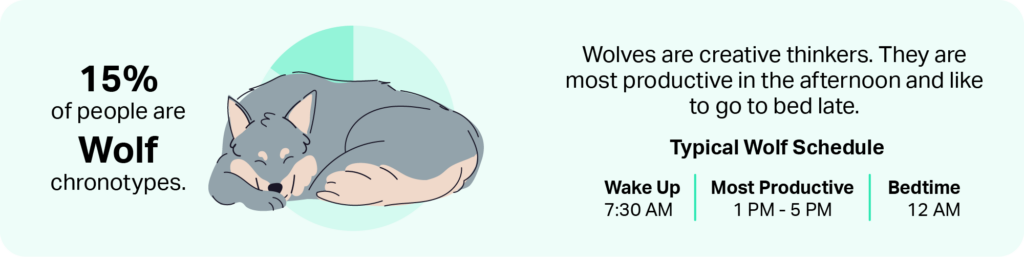
Wolves are the classic night owls. They struggle with early mornings and often feel a fog that doesn't lift until the afternoon. When we discuss morning person vs evening person traits, Wolves are the extreme end of the evening spectrum. They experience a "second wind" in the late evening, making it the best time for deep work based on chronotype results for this group.
The Dolphin: The Sensitive Sleeper
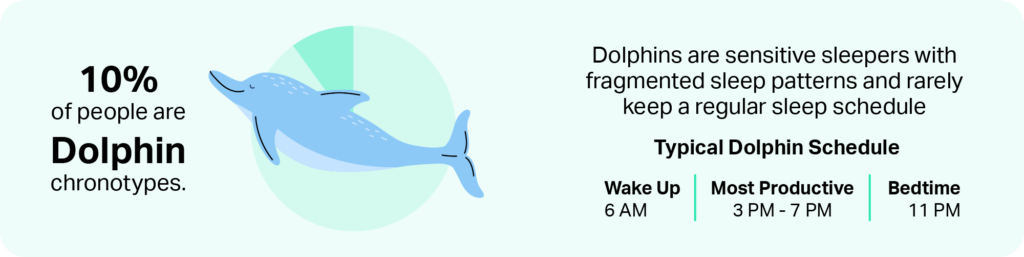
Dolphins are unique because their brain remains alert even while they try to rest. They are often diagnosed as insomniacs, but in reality, their circadian rhythms are simply wired for high sensitivity. They may struggle to find a consistent schedule, often reaching peak productivity in short bursts throughout the mid-afternoon.
The Science of Success: Synchronizing Your Biological Clock
The benefits of taking a chronotype quiz for productivity are backed by significant scientific data. Our internal clocks are not just "habits"—they are genetic predispositions. Research into the PER3 gene shows that some people are biologically hardwired to be alert at night.
The primary health challenge for many is social jetlag. This occurs when there is a mismatch between your internal biological clock and the external demands of your job or social life. For a Wolf, being forced to start work at 8:00 AM is equivalent to a Bear suffering from permanent jetlag. This misalignment isn't just a matter of feeling tired; it can lead to higher cortisol levels, increased inflammation, and a higher risk for metabolic disorders.
Managing social jetlag for night owl chronotypes requires strategic lifestyle changes. If you are a night owl, you aren't "lazy"—you are simply living in a world designed for Lions and Bears. By using bright light exposure in the morning and maintaining a strict sleep-wake consistency, you can shift your rhythm slightly, but the goal should always be to find a lifestyle that respects your natural energy peaks.
Chronotype Schedule Optimization: Your Daily Roadmap
Once you have identified your sleep personality types, the next step is chronotype schedule optimization. By aligning your most difficult tasks with your productivity windows, you can achieve more in less time.
Sample Daily Roadmap: The Lion
- 5:30 AM – 7:00 AM: Wake up, exercise, and eat a high-protein breakfast.
- 8:00 AM – 12:00 PM: Deep work. This is your window of peak alertness for analytical tasks.
- 12:00 PM – 2:00 PM: Administrative tasks or meetings.
- 3:00 PM – 5:00 PM: Light tasks and winding down.
- 9:00 PM – 10:00 PM: Sleep.
Sample Daily Roadmap: The Bear
- 7:00 AM – 8:00 AM: Wake up and get sun exposure.
- 10:00 AM – 2:00 PM: Focus on deep work and complex problem-solving.
- 2:00 PM – 4:00 PM: Socializing, meetings, and collaboration.
- 4:00 PM – 6:00 PM: Exercise.
- 10:30 PM – 11:00 PM: Sleep.
Sample Daily Roadmap: The Wolf
- 8:30 AM – 9:30 AM: Wake up, use a lightbox or get direct sun to signal the day.
- 10:00 AM – 1:00 PM: Routine tasks, emails, and logistical work.
- 2:00 PM – 5:00 PM: Social interaction and meetings.
- 5:00 PM – 9:00 PM: Deep work. Use your "second wind" for creative projects.
- 12:00 AM – 1:00 AM: Sleep.
Sample Daily Roadmap: The Dolphin
- 7:30 AM – 8:30 AM: Wake up, start with a cold shower to boost alertness.
- 10:00 AM – 12:00 PM: Administrative work.
- 3:00 PM – 7:00 PM: Focus on high-intensity tasks.
- 9:00 PM – 11:00 PM: Mandatory "digital sunset" with no screens to lower melatonin levels naturally.
- 11:30 PM: Sleep.
Optimizing daily schedules for different sleep personality types means more than just moving your work hours; it involves timing your meals and workouts too. For instance, Wolves should avoid heavy meals late at night despite their late-night energy, as it can further disrupt their sleep-wake consistency.
FAQ
What is a chronotype quiz?
A chronotype quiz is a self-assessment tool designed to help you discover your natural circadian rhythm. By asking about your energy levels, sleep preferences, and daily habits, it categorizes you into a specific sleep personality type, such as a Lion, Bear, Wolf, or Dolphin.
What are the four main sleep chronotypes?
The four main chronotypes are the Lion (early morning peak), the Bear (daylight peak), the Wolf (evening peak), and the Dolphin (irregular/alert peak). These archetypes help simplify the complex science of chronobiology into actionable categories.
How do I find out what my chronotype is?
You can find your type by taking a sleep personality quiz that tracks your peak alertness, hunger patterns, and natural wake times. Observing your energy levels over a weekend when you don't have an alarm clock set is also a great way to identify your natural biological clock.
How can knowing my chronotype improve my productivity?
Knowing your type allows you to schedule your most cognitively demanding work during your specific productivity windows. This alignment, known as the Synchrony Effect, can make you up to 30% more effective and significantly reduce the mental fatigue caused by working against your natural rhythms.
Are chronotype tests scientifically accurate?
While these tests are based on validated scientific concepts like the Munich Chronotype Questionnaire (MCTQ), they are tools for self-discovery rather than medical diagnoses. They are highly accurate in identifying general trends in your biological clock and genetic predisposition toward being a morning or evening person.
By shifting our perspective from "early is better" to "timing is everything," we can create a lifestyle that supports our long-term health. Whether you are a Lion leading the charge at dawn or a Wolf creating masterpieces at midnight, your rhythm is your strength.