
Quick Facts
- Success Rate: Lifters who log their sessions gain 25-47% more strength than those who do not.
- Volume Sweet Spot: Aim for 10-20 challenging sets per muscle group per week for optimal growth.
- Rest Duration: Allow 3-5 minutes of rest between heavy sets to ensure absolute strength recovery.
- Safety Trigger: Avoid testing your one-rep max if your systolic blood pressure exceeds 200mmHg.
- Progression Signal: Initial neurological adaptation usually manifests within the first 7 days of a new program.
- The 10-Second Rule: Record your data immediately after a set to maintain accuracy without breaking your gym flow.
To accurately track strength training progress, maintain a detailed workout log recording the exercises, sets, repetitions, and weight used in every session. Beyond the numbers, monitor movement proficiency and central nervous system fatigue to gauge neurological adaptation. Regularly testing your one-repetition maximum (1RM) or high-rep sets with a consistent weight provides a benchmark for absolute and relative strength gains over time.
The Core Metrics: Beyond the Weight on the Bar
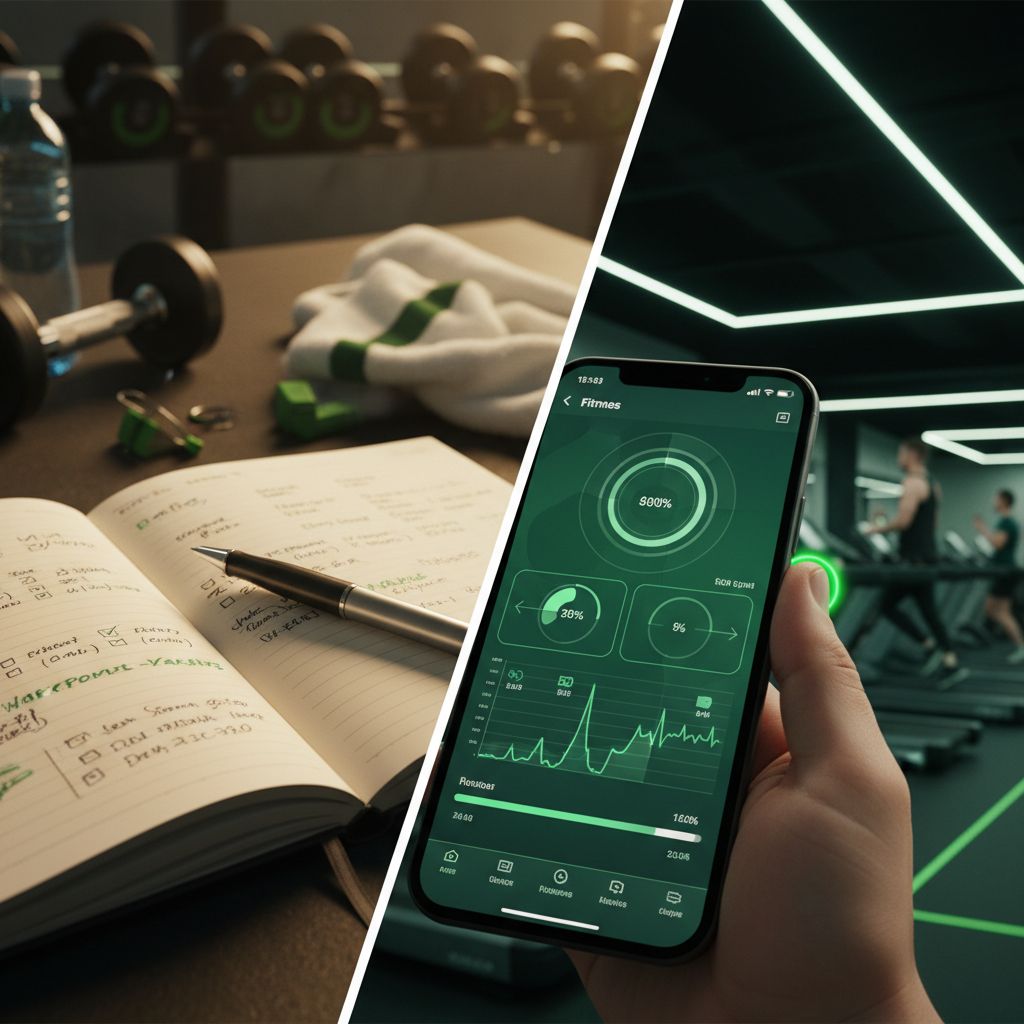
Many athletes make the mistake of only looking at the number on the plates. While increasing the load is a primary driver of progressive overload, it is only one piece of the puzzle. To truly understand your strength training progress, you need a multi-dimensional approach to data. I tell my athletes to follow the 10-second rule: as soon as you rack the bar, you have ten seconds to log your reps and RPE (Rate of Perceived Exertion). This ensures your workout log essentials are captured while the feeling of the set is fresh.
A robust log should move beyond just weight. You must track metrics for tracking strength training progress besides weight such as training volume load, which is the total tonnage moved (sets x reps x weight). If your squat weight stays the same for two weeks but you add an extra set or two extra reps, your training volume load has increased, signaling progress. Another critical factor is movement proficiency. Are you hitting the same depth on your squats? Is your lockout speed increasing on the bench press? These qualitative markers indicate that your nervous system is becoming more efficient.
The following beginner workout log essentials for strength training should be your non-negotiables:
- Date and time of the session
- Specific exercise name (e.g., Low-Bar Back Squat vs. Goblet Squat)
- Exact load used
- Completed repetitions and sets
- Rest intervals taken between sets
- Notes on form video analysis or perceived difficulty
Focusing on rest intervals is particularly important for those chasing absolute strength. If you decrease your rest from four minutes to two minutes while maintaining the same weight and reps, you have improved your work capacity. However, if your goal is max force production, cutting rest too short can hinder your ability to recruit high-threshold motor units.
Mastering One-Rep Max Testing Safely
There is a certain thrill in discovering exactly how much weight you can move for a single repetition. However, one-rep max testing is a high-stress event that requires a systematic approach to prevent injury. Before you even touch the bar for a max attempt, you must consider exercise mechanics and your current physical state. If you are recovering from a minor tweak or have high blood pressure, skip the max effort day.
If you are wondering how to safely test one rep max, follow this 12-step protocol:
- Perform a general dynamic warm-up for 5-10 minutes.
- Complete 8 reps at 40-60% of your estimated maximum.
- Rest for 1 minute.
- Complete 5 reps at 70% of your estimated maximum.
- Rest for 2 minutes.
- Complete 3 reps at 80% of your estimated maximum.
- Rest for 3 minutes.
- Complete 1 rep at 90% of your estimated maximum.
- Rest for 3-5 minutes.
- Attempt your first 1RM at 95-100% of your target.
- If successful, rest 5 minutes and increase the load by 2-5% for a second attempt.
- Stop once you reach a failed attempt or a breakdown in form.
For many lifters, especially during a hypertrophy phase, a true 1RM test is not always necessary. You can use submaximal testing to estimate your strength. A heavy set of 3 to 5 repetitions can be used with a 1RM calculator to provide a 95-98% accurate estimation without the extreme neurological adaptation stress of a true max.
| Reps Performed | % of 1RM (Estimated) | Accuracy for Strength Tracking |
|---|---|---|
| 1 | 100% | Absolute |
| 2 | 95% | Very High |
| 3 | 93% | High |
| 5 | 87% | Moderate-High |
| 8 | 80% | Moderate |
| 10 | 75% | Low (Better for Hypertrophy) |
Analyzing Data to Break Through Plateaus
The real power of tracking your strength training progress comes when the gains stop. Every lifter eventually hits a wall. This is where you stop being a "gym-goer" and start being a "data scientist." Overcoming strength plateaus requires a diagnostic look at your training history. If you have been stuck at the same bench press weight for three weeks, you need to analyze your workout log for plateaus to find the culprit.
Usually, the problem falls into one of two categories: intensity or recovery. If your training volume load has been steadily increasing but your top-end strength is flat, you might be experiencing central nervous system fatigue. In this case, adjusting training volume to break strength plateaus is often a matter of doing less, not more. Implementing a deload week—where you reduce your intensity and volume by 30-50%—allows your body to supercompensate and return stronger.
If you are not feeling fatigued but the weight simply won't move, you may need to look at mesocycle planning. Are you hitting the same accessory movements every week? Maybe you need to address a specific sticking point. If your deadlift stalls at the floor, you might need more deficit deadlifts to build explosive power. If it stalls at the knees, rack pulls might be the answer. Timing deload weeks for optimal strength gains is essential to keep the trend line moving upward over months and years.

A study published in the Journal of Sports Sciences found that lifters who maintained detailed training logs increased their strength by an average of 25% more than those who trained without tracking their workouts. Furthermore, research involving intermediate lifters over 24 weeks showed that those who kept detailed logs achieved average strength gains of 47% on main lifts, significantly outperforming a non-logging control group that averaged 18% gains. These numbers prove that data is just as important as sweat.
The Holistic Factor: Recovery and Biofeedback
Your performance in the gym is a reflection of your life outside the gym. If your sleep quality is poor or your macronutrient tracking shows a massive calorie deficit, your strength training progress will suffer regardless of how perfect your program is. Tracking recovery habits is the secret weapon of elite athletes.
I recommend my trainees keep a simple biofeedback checklist. Each morning, rate the following on a scale of 1-5:
- Sleep Quality: Did you wake up feeling rested?
- Motivation to Train: Are you excited to hit the weights or dreading the session?
- Muscle Soreness: Is the soreness localized or systemic?
- Mood/Stress: High external stress levels consume the same recovery resources as a heavy squat session.
Monitoring these signs of central nervous system fatigue helps you determine your training frequency. If you consistently score 1s and 2s on your biofeedback, it is a signal to pull back, even if your workout log suggests you should be adding weight. Additionally, using form video analysis can help you spot "technical fatigue." When your technique starts to shift—even slightly—before you actually fail a rep, it is time to end the set. This proactive approach prevents injury and ensures every rep contributes to long-term gains.

FAQ
What are the first signs of strength training progress?
The earliest signs are often neurological adaptation rather than muscle growth. You will find that exercises feel more "coordinated," your balance improves, and you can complete the same number of reps with less effort. Within the first week or two, you may notice that "lockout speed" increases, meaning you are moving the weight faster through the full range of motion.
How often should I increase weights in my workout?
For beginners, you can often increase the weight every session or every week, a concept known as linear progression. However, as you become more advanced, you might only increase the weight every 3-4 weeks. The key is to follow a plan of progressive overload where you increase either the weight, the reps, or the number of sets consistently over a training cycle.
Why is my strength training progress stalling?
Plateaus typically happen because of a lack of recovery, insufficient training stimulus, or a lack of variety in accessory work. If you are sleeping and eating enough but still stalling, you may need to look at adjusting training volume to break strength plateaus. Sometimes, simply changing the rep range for a few weeks can re-sensitize your body to the training stress.
How do I track my progress in the gym?
Use a dedicated workout log—either a physical notebook or a mobile app—to record the weight, reps, and sets for every exercise. To get a complete picture, also track your rest intervals, RPE, and use form video analysis to ensure your technique remains consistent as the weight gets heavier.
Is it better to increase reps or weight for progress?
Both are valid forms of progress. Increasing reps with a fixed weight improves your muscular endurance and volume load, while increasing weight improves your absolute strength. A common strategy is to "cycle" these: increase reps until you hit a target (e.g., 3 sets of 10), then increase the weight and drop the reps back down (e.g., 3 sets of 8) to start the process again.
Effective strength training is a marathon, not a sprint. By moving away from guesswork and toward a data-driven approach, you ensure that every drop of sweat in the gym results in a tangible gain on the bar. Start your 12-week tracking journey today, and stop leaving your results to chance.